
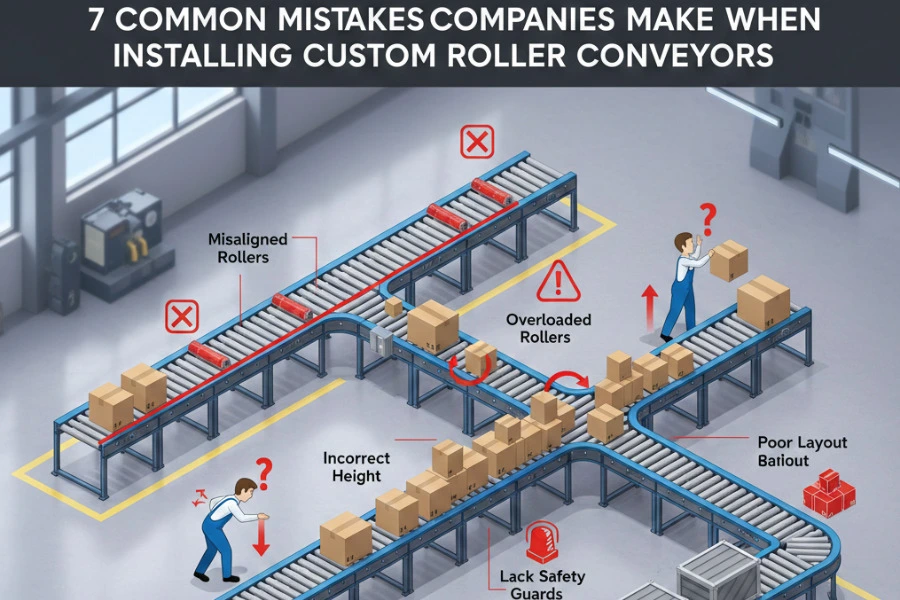
Installing a custom roller conveyor should boost efficiency, not add problems.
But here’s the reality:
Most conveyor issues don’t come from the equipment.
They come from mistakes made before and during installation.
The good news?
You can avoid all of them — and Mexeltec can help you do it right the first time.
Let’s break down the biggest installation mistakes and how to avoid them.
1. Not Defining the Real Purpose of the Conveyor
Most conveyor failures start with unclear goals.
If you don’t know exactly what the conveyor should do—
Move heavy loads? Speed up order picking? Improve baggage handling? Automate truck loading?
—your system will never be optimized.
Fix: Define the purpose clearly. Mexeltec designs custom roller conveyors based on your exact operational needs so you don’t waste money on the wrong setup.
2. Ignoring Load Specifications
Rollers don’t break because they’re weak.
They break because the wrong roller type was selected.
Every roller has limits:
- Load per roller
- Conveying speed
- Material suitability
Guessing these specs = guaranteed downtime.
Fix: Know your load requirements before selecting rollers. Mexeltec calculates load capacity and speed needs to ensure long-term performance.
3. Poor Layout Planning
A poor conveyor layout slows everything down.
Worse—fixing it later is expensive and disruptive.
Bottlenecks, unnecessary turns, and bad flow design can ruin your throughput.
Fix: Map material flow first. At Mexeltec, we plan layouts that eliminate workflow friction and maximize floor space.
4. Forgetting Future Expansion
A conveyor built only for today becomes a bottleneck tomorrow.
If your business grows, your conveyor must scale with it.
Fix: Choose modular designs. Mexeltec builds expandable conveyor systems so you can scale without full replacements.
5. Underestimating Safety Requirements
Skipping safety during installation is a major risk.
Missing emergency stops, roller guards, or safety rails can cost you far more later.
Fix: Follow safety standards. Mexeltec integrates international safety compliance into every installation.
6. Installing Without Proper Leveling
A slightly uneven roller conveyor creates huge problems:
- Load drifting
- Roller jamming
- Excess noise
- Motor stress
Precision matters.
Fix: Level the conveyor perfectly. Mexeltec uses professional alignment tools to ensure flawless installation.
7. Skipping Testing & Calibration
“Install → Turn on → Hope for the best”
This is the most common mistake.
A conveyor needs proper testing, including:
- Load simulation
- Alignment check
- Speed calibration
- Full dry runs
Skipping these steps invites operational failures.
Fix: Test everything before going live. Mexeltec performs full commissioning and testing on every installation.
Final Thoughts
A custom roller conveyor is an investment.
Avoiding these mistakes ensures it delivers maximum efficiency, safety, and ROI.
If you want expert installation, planning, and long-term support, Mexeltec provides complete conveyor solutions — from design to commissioning.